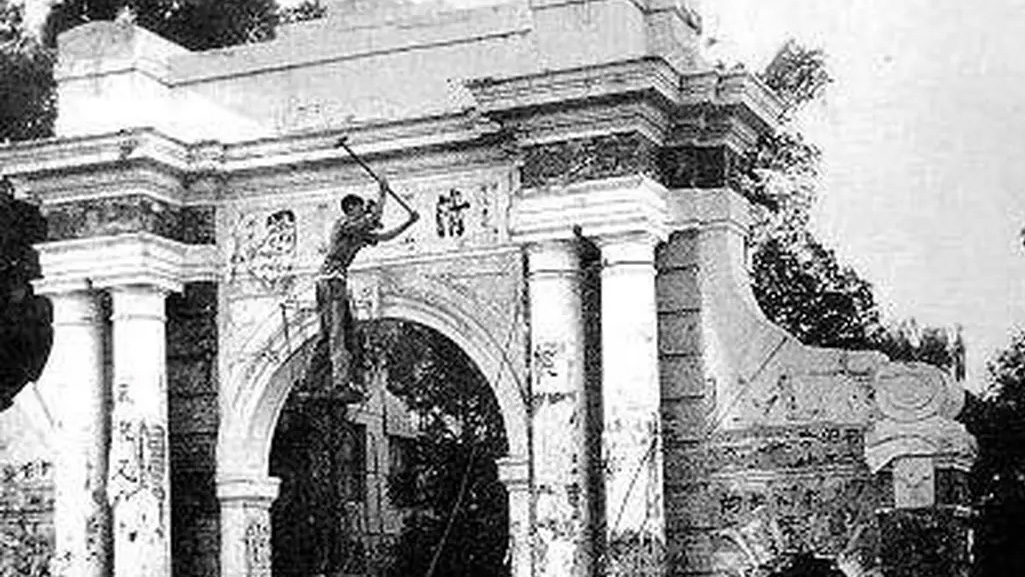
The Cultural Revolution (文化大革命, Wénhuà Dàgémìng) was a political and social movement in the People’s Republic of China that lasted from 1966 to 1976, initiated and led by Mao Zedong, the Chairman of the Communist Party of China. The movement was aimed at preserving Communist ideology by removing capitalist, traditional, and cultural elements from Chinese society and to enforce Maoist thought. It is often considered one of the most chaotic and violent periods in modern Chinese history.
Key Objectives of the Cultural Revolution:
- To Reinforce Mao’s Ideology: Mao wanted to consolidate his power within the Communist Party and eliminate any potential opposition. The movement was also intended to solidify Mao Zedong Thought as the guiding ideology of the Communist Party and the country.
- To Remove Capitalist Elements: Mao sought to eliminate capitalist and traditional influences within Chinese society, especially those associated with the old intellectual class, bureaucratic elites, and cultural traditions that he viewed as harmful to the socialist revolution.
- To Combat “Revisionism”: Mao believed that after the establishment of the People’s Republic of China in 1949, certain members of the Communist Party were becoming too aligned with capitalist principles, particularly under the leadership of Liu Shaoqi and Deng Xiaoping. The Cultural Revolution was seen as an effort to “purge” these so-called “revisionists.”
- To Mobilize the Youth: One of the key features of the Cultural Revolution was the involvement of young people, particularly students. Mao encouraged them to form Red Guards—groups of radical students tasked with attacking perceived counter-revolutionary forces, including teachers, intellectuals, and anyone associated with the old societal structures.
Key Phases of the Cultural Revolution:
- Early Phase (1966-1969):
- The Cultural Revolution officially began in 1966 when Mao launched the May 16 Directive, which aimed at removing capitalist and traditional elements from Chinese society.
- Mao called upon young people, particularly students, to form Red Guard groups, who went around the country attacking people and institutions associated with the old culture.
- Red Guards targeted intellectuals, teachers, and those deemed to be “counter-revolutionaries,” often subjecting them to public humiliation, violence, and imprisonment.
- Many cultural and historical sites, including ancient monuments, temples, and books, were destroyed. Thousands of intellectuals were persecuted, forced to “re-educate” themselves through manual labor in rural areas, and some were tortured or killed.
- Culmination and Decline (1969-1976):
- In 1969, Mao began to shift focus away from the Red Guards, who had caused widespread chaos, and started reasserting the central authority of the Communist Party.
- During this time, the People’s Liberation Army (PLA) was sent in to restore order and discipline, and the Red Guard movement gradually fizzled out.
- However, the Cultural Revolution’s effects on the country were far-reaching. The “Gang of Four,” a group of radical leaders, played an important role in continuing the purges until Mao’s death in 1976.
Key Figures Involved:
- Mao Zedong: The leader of the Communist Party and the initiator of the Cultural Revolution. Mao sought to eliminate perceived counter-revolutionary elements in society and solidify his personal power.
- Lin Biao: Mao’s Vice Chairman and designated successor before falling out of favor. Lin was an important figure in the early stages of the Cultural Revolution, especially in organizing the Red Guards and military support. He later died in a mysterious plane crash in 1971 after allegedly attempting a coup against Mao.
- Zhou Enlai: The Premier of China during much of the Cultural Revolution, who attempted to mitigate some of the damage caused by the movement. However, Zhou’s position was weakened by the rise of the Gang of Four.
- Gang of Four: A radical political faction within the Chinese Communist Party, led by Jiang Qing (Mao’s wife), Zhang Chunqiao, Yao Wenyuan, and Wang Hongwen. They played a significant role in carrying out the Cultural Revolution’s violent campaigns, promoting revolutionary ideology, and persecuting perceived enemies.
Impact of the Cultural Revolution:
- Destruction of Traditional Culture: The Cultural Revolution sought to eliminate what was considered “old” or “feudal” culture, including traditional Chinese customs, values, and religious practices. Numerous historical relics, temples, and artifacts were destroyed, and many classical Chinese works of art, literature, and philosophy were banned or burned.
- Mass Persecution of Intellectuals: One of the most tragic consequences of the Cultural Revolution was the persecution of intellectuals. Scholars, teachers, and anyone associated with “bourgeois” ideas were subjected to public humiliation, imprisonment, and often physical violence. Many were sent to the countryside for “re-education” through hard labor. Some were killed or died as a result of the violence.
- Economic Disruption: The Cultural Revolution also caused significant disruptions in China’s economy. Many factories, schools, and institutions were shut down or restructured according to revolutionary ideals, leading to a breakdown in productivity. The focus on ideology over expertise caused setbacks in industrial and agricultural development.
- Human Rights Violations: During the Cultural Revolution, millions of people were persecuted, including torture, imprisonment, forced labor, and executions. The violence reached a point where entire communities were torn apart by accusations of counter-revolutionary activity.
- Political Fallout: The Cultural Revolution ultimately destabilized the Chinese government and caused profound political damage to the Communist Party. Many Party leaders were purged, including Liu Shaoqi, who was condemned as a “capitalist roader” and died in prison, and Deng Xiaoping, who was publicly humiliated and removed from power.
- Mao’s Legacy: After Mao’s death in 1976, the Cultural Revolution was officially condemned by the Chinese Communist Party under the leadership of Deng Xiaoping. Deng initiated a process of “reform and opening up,” leading to significant political and economic changes in China, moving away from the extreme ideology of the Cultural Revolution.
Aftermath and Reconciliation:
- Following Mao Zedong’s death in 1976, the Chinese government moved away from the radical policies of the Cultural Revolution.
- Deng Xiaoping emerged as the leader, and the Cultural Revolution was officially denounced as a “catastrophe” for China, with a formal apology issued by the government.
- Many of the people involved in the violence of the Cultural Revolution, such as the Gang of Four, were arrested and put on trial.
The Cultural Revolution was a tumultuous period in China’s history that led to widespread social, political, and cultural upheaval. While it was intended to strengthen communism in China, it ended up causing immense human suffering, economic disruption, and a deep division within the Chinese Communist Party. The movement left lasting scars on Chinese society, and it remains a highly sensitive and controversial topic in China today.