
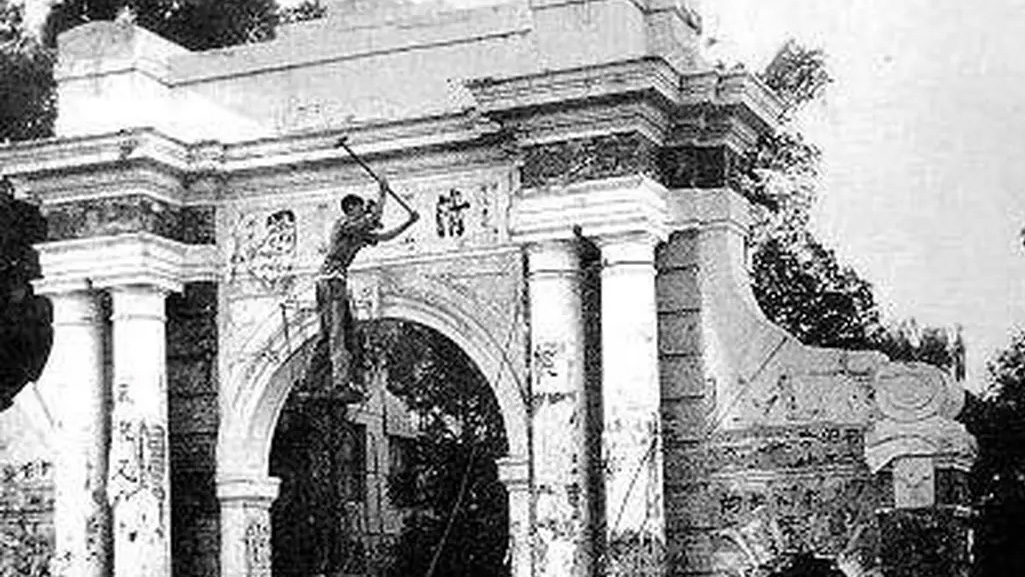
The Cultural Revolution (1966-1976), initiated by Mao Zedong and the Chinese Communist Party, aimed to enforce Maoist ideology, eliminate capitalist and traditional elements, and reaffirm the revolution’s power. One of the most significant impacts of the Cultural Revolution was the widespread destruction of China’s traditional culture. The movement sought to eradicate what Mao and his supporters considered “old” cultural practices, values, and artifacts in favor of a new, socialist culture based on revolutionary ideals.
Here’s how the Cultural Revolution systematically dismantled traditional Chinese culture:
1. Attack on Religious Practices and Beliefs
- Buddhism, Confucianism, Taoism and other traditional religions and philosophies were targeted. Temples, shrines, and religious sites were desecrated or destroyed. Religious texts were burned, and religious leaders were persecuted, humiliated, or executed.
- Traditional beliefs and practices such as ancestor worship, which was integral to family life and respect for elders, were condemned as “feudal” and “superstitious.”
2. Destruction of Historical Artifacts and Cultural Relics
- Historical relics, ancient architecture, artworks, and other artifacts were seen as symbols of China’s feudal past and were destroyed or defaced. Ancient texts, paintings, porcelain, and statues were burned or smashed by the Red Guards (the paramilitary youth groups mobilized during the Cultural Revolution).
- Cultural heritage that had survived for centuries was obliterated in the name of ideological purity. This included the destruction of temples, palaces, libraries, and other sites of cultural importance.
- The Forbidden City and Summer Palace, which housed priceless artifacts, were also subjected to attacks, and many ancient treasures were lost.
3. Persecution of Intellectuals
- Intellectuals were targeted for their perceived association with traditional culture and Western ideas. Scholars, teachers, writers, and artists were labeled as “reactionary” and “counter-revolutionary.”
- Intellectuals were publicly humiliated, tortured, and sent to re-education camps for forced labor in rural areas. Universities were closed, and education was disrupted, as the focus shifted from traditional academic learning to ideological indoctrination.
- Intellectuals who had contributed to the preservation and study of China’s cultural heritage were subjected to “struggle sessions”, where they were publicly denounced and forced to denounce their own beliefs.
4. Suppression of Traditional Art Forms
- Chinese opera, classical music, and other traditional art forms were banned or heavily censored, deemed to be backward or bourgeois. Traditional artists and performers were persecuted, and performances were replaced by revolutionary operas and propaganda plays that promoted the ideals of the Communist Party.
- The Peking Opera and other traditional performances were restructured to reflect Maoist themes, often featuring revolutionary heroes and struggles, thus distorting the historical narratives of China’s cultural past.
5. Destruction of Confucian Values
- The Cultural Revolution sought to erase the influence of Confucianism, which had been central to Chinese society for over two thousand years. Confucian values of family, respect for elders, and social hierarchy were rejected as signs of feudalism.
- Confucian teachings on filial piety, respect for authority, and the role of the family were portrayed as oppressive and counter-revolutionary. The Communist Party attempted to replace these with the ideals of class struggle, collective identity, and loyalty to Mao.
6. The Attack on “Old Customs, Old Culture, Old Habits, and Old Ideas”
- The slogan “Destroy the Four Olds” (旧四旧: Old Customs, Old Culture, Old Habits, and Old Ideas) became central to the Cultural Revolution. This campaign aimed to completely eliminate China’s ancient traditions, customs, and values. It was not just about physical destruction; it was also a deep ideological shift intended to reshape Chinese society.
- Traditional festivals and family practices were banned or replaced with revolutionary ceremonies. Chinese traditional medicine, literature, and even folk customs came under attack.
7. Cultural Re-education and Propaganda
- Red Guards, often young students, were tasked with re-educating the masses by destroying anything deemed “old.” This led to a campaign of mass denunciations, where people were forced to publicly criticize their own families, teachers, and neighbors.
- The cultural policies of the Cultural Revolution promoted Mao Zedong Thought as the foundation of Chinese culture. Revolutionary songs, literature, and art were encouraged, while anything associated with the old society, including classical Chinese philosophy, literature, and art, was rejected.
- Revolutionary propaganda was pervasive, encouraging people to conform to socialist values and to adopt Maoist teachings in their daily lives.
8. Erasure of China’s Cultural Identity
- The mass destruction and radical reforms during the Cultural Revolution led to a break in the continuity of China’s cultural traditions. The rich history of China, including its dynastic eras, Confucian ethics, and long-standing cultural practices, was overshadowed by a radical and homogenized socialist agenda.
- Cultural memory of the imperial dynasties, traditional customs, and intellectual achievements of China’s past were erased from public consciousness in favor of a new, ideologically driven culture based on Maoism and communism.
9. Impact on Language and Literature
- The Chinese language was also subjected to revolutionary changes. In many cases, words, phrases, and even literature that were tied to traditional ideas were altered or banned. Classical Chinese literature, which had been an essential part of Chinese education and identity, was largely dismissed in favor of Maoist and socialist themes.
- Writers, poets, and artists were often forced to align their work with the Communist Party’s principles. Literature and art became tools for political propaganda, severely limiting the diversity of expression in Chinese culture.
Legacy of the Cultural Revolution’s Impact on Traditional Culture
While the Cultural Revolution ultimately ended in 1976 with Mao Zedong’s death, its legacy of cultural destruction continues to be felt in China. Thousands of years of cultural heritage were lost or severely damaged during the ten years of radical reform. In the aftermath, the Chinese government under Deng Xiaoping sought to restore and preserve Chinese traditions, but the scars left by the Cultural Revolution still remain in Chinese cultural memory.
Although there have been efforts to recover traditional cultural practices, art forms, and religious beliefs, the Cultural Revolution left a deep psychological and cultural wound, leading to a generation that was deprived of China’s rich heritage. Many younger generations only began to fully understand the significance of this loss after China opened up to more diverse cultural exchanges in the late 20th and early 21st centuries.
The Cultural Revolution was a deeply destructive force for traditional Chinese culture. It sought to replace centuries of Chinese tradition with a new, ideologically driven culture focused on the teachings of Mao Zedong. Through the destruction of historical relics, the persecution of intellectuals, and the suppression of traditional art and beliefs, the movement caused irreparable damage to China’s cultural heritage. The lasting effects of the Cultural Revolution can still be seen today in the country’s cultural landscape.
